
Gloucester Township Previous Residents by Era
Finding previous residents calls for an era-by-era record trail. Recorded deeds document ownership, but the person who owned a parcel is not automatically the person who lived there. Directories and census schedules can offer dated household clues. Maps and permits can show how a site changed. Gloucester Township questions also cross jurisdictions: a pre-1844 record may be described under Old Gloucester County, while later land records are in Camden County. Retain the original location words and legal description when a modern address search fails.
| Historic source | Years it covers | Where held | What it can show |
|---|---|---|---|
| Camden Clerk online index | 1978-present | Online property-record portal | Recorded instruments and the modern ownership trail |
| Early deeds and deed books | 1847-1961 references; collection-specific coverage varies | Clerk counter and CCHS | Grantor, grantee, and legal-description clues |
| Camden County Library directories | 1863/64-1947, with listed gaps | Second-floor microfilm and reference area | Address and name clues; Gloucester named in 1940-47 local-town reels |
| CCHS directories and telephone books | Directories most years 1839-1947; telephone books 1921-1998 | Richard H. Hineline Research Library | Historical address, business, and telephone clues |
| Federal census | Camden County 1850-1930 at the Library; later release follows the 72-year rule | Library microfilm and genealogy databases | Dated household snapshot, not ownership proof |
| Sanborn maps | 1885, 1891, 1906, 1926 named by CCHS | CCHS and Library of Congress routes | Building footprint, use, and street context |
| Planning/construction file | Start year not located | Township Planning/Construction | Permits and jacket evidence where retained |
Begin with the source nearest the time period in question. A recent transfer is best approached through the Clerk index. For an older household question, use the library, CCHS, or a staff research request rather than treating the 1978 online date as the beginning of local records.
Note: A gap in the directory reels or a missing historic collection does not prove that a household moved away.
Start Gloucester Township Previous Residents at the Parcel
Use the current parcel to stabilize an address before following past residents. The Township Tax Office confirms searches by Address, Property ID/PIN/Folio, and Street Name & Number. Its map route can return View Property and a printable PDF map. The Municipal Assessor maintains parcel-related names, addresses, deed information, assessment descriptions, deductions, and maps for about 22,500 parcels. Copy the property identifier, block/lot, current situs address, and legal-description clues that are actually displayed.
A tax mailing address is correspondence information, not an occupancy finding. A legal description can be more durable than a house number because old deeds may use a subdivision, metes and bounds, or a plan instead of a modern street format. The local GIS is useful for finding the parcel and its street context, but its public text view did not establish a full owner-card field list.
Gloucester Township's GovPilot GIS is the source for the address-or-place map view used at the start of an address history.
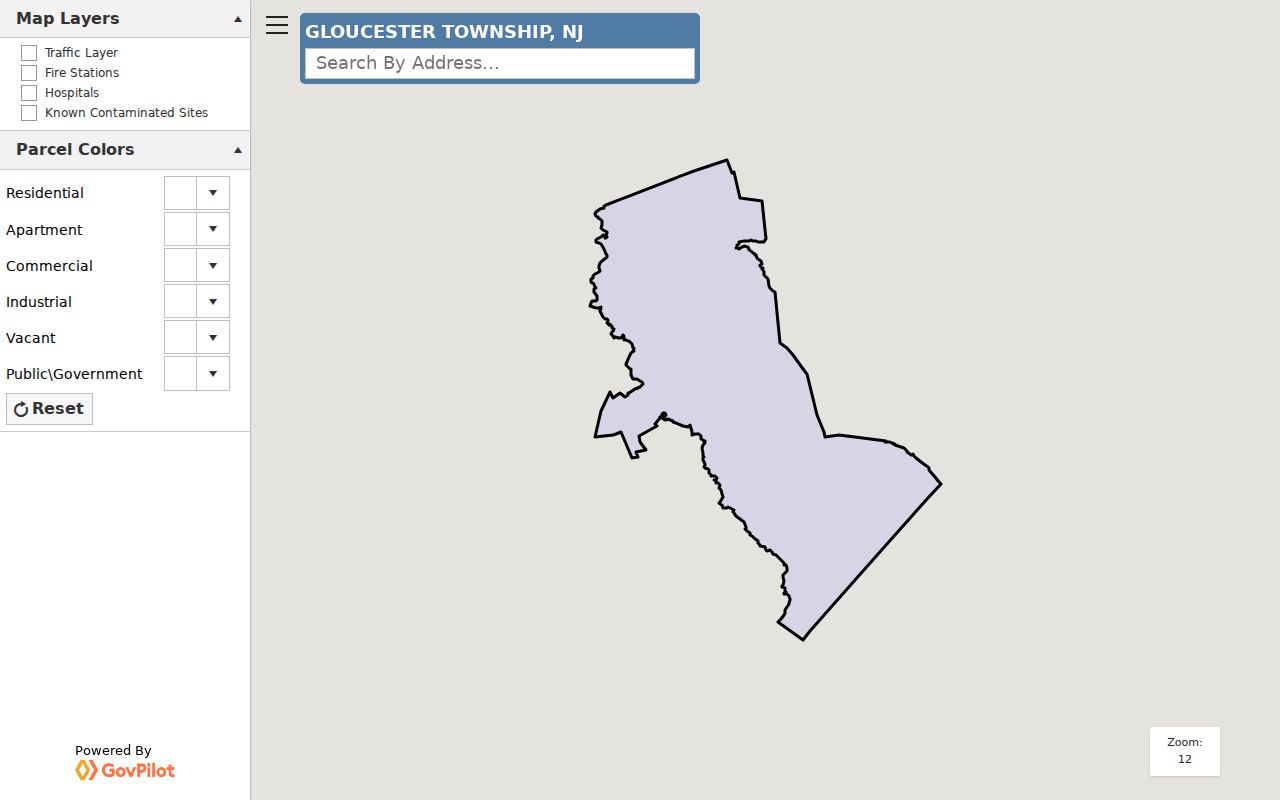
The map screen helps tie an address to its parcel and nearby labels before a deed or directory search begins.
Trace Gloucester Township Previous Residents Through Deeds
The Camden County Clerk's property index is the key digital starting point for a post-1978 ownership trail. It is updated nightly. Basic search and printing are free, and Basic images carry an unofficial watermark. Premium is $25 per month with a one-time account setup, unwatermarked images, and broader document categories. The source confirms free search, registered-user access, and an instructions route, but it did not expose complete live field labels. Use the current interface to verify its exact search options.
- Use the parcel record to identify the current owner, legal description, and a likely deed reference where shown.
- Search the current owner as a grantee in the Clerk index and match the likely purchase instrument by legal description and date context.
- Record the seller, or grantor, from that instrument. Search the grantor as a prior grantee to locate the earlier acquisition.
- Repeat the grantee-to-grantor sequence, testing spelling, spouse, trust, and entity variants when the chain pauses.
- When the trail reaches before 1978, shift to the Clerk counter or deed books, CCHS early deeds, and historical research support.
- Grantor and grantee
- The grantor transfers an interest in the property; the grantee receives it. The roles help reverse a deed chain.
- Chain of title
- The sequence of recorded transfers and related instruments connecting one owner to an earlier one.
- Legal description
- The land identifier in the recorded document, such as block and lot, a subdivision, or metes and bounds. It can outlast address changes.
The Camden Clerk property-record portal is the official entry point captured for the 1978-present index.
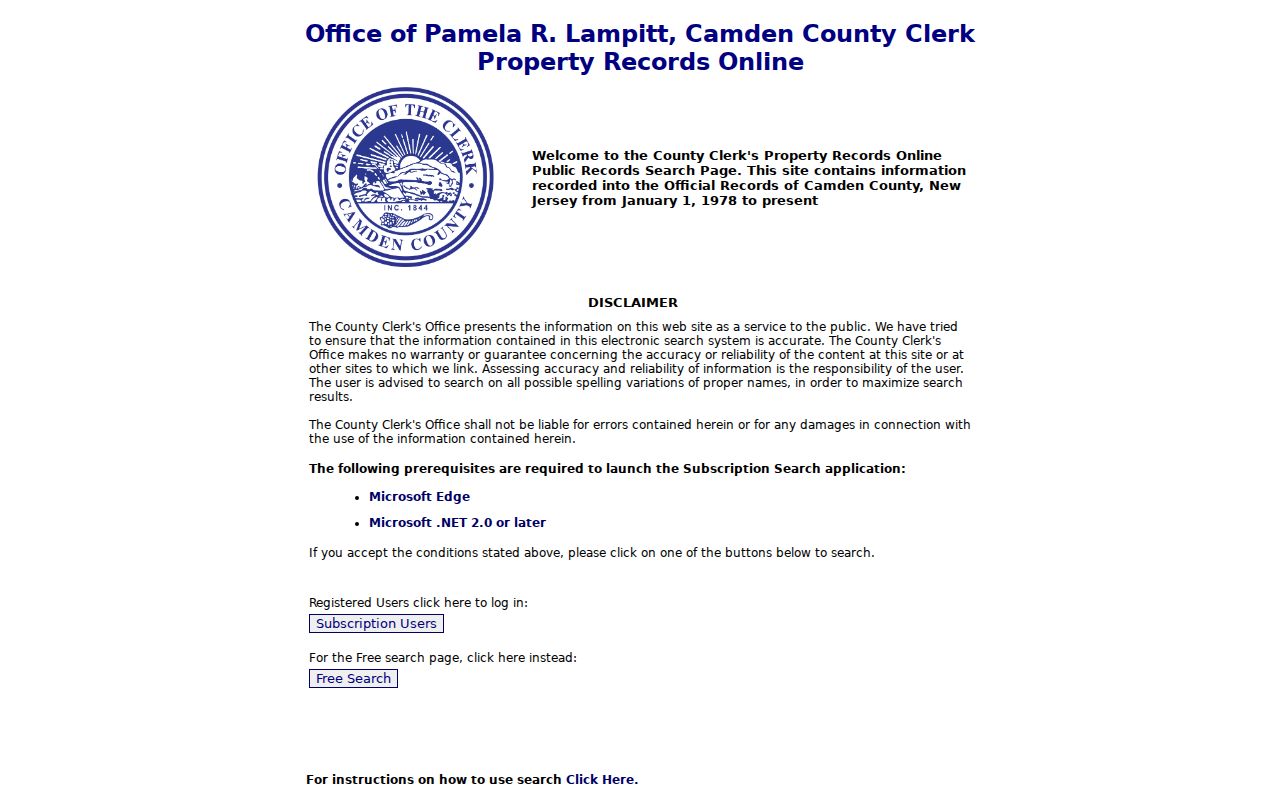
The portal view confirms the free and registered-user routes, while the Clerk's online coverage date signals when an earlier repository is needed.
Gloucester Township Previous Residents Before 1978
The Clerk's 1978-present online range is a digital access boundary, not a claim that older Camden County records are absent. Earlier deeds may be reached through the Clerk's counter, deed books, CCHS, the library, or a records request. CCHS reports nearly 4,000 original deeds, including some early and unrecorded material. A request works better with current and old address spellings, block/lot when known, a likely time range, and a clear question about ownership, an occupant, a building event, or a family connection.
For a document that is not online, the access channels are broader than a screen search: use the Clerk portal first, call or visit the Registry Division, consider Premium when the needed image route is supported, make a targeted OPRA request to the correct custodian, and consult CCHS for early real-estate holdings. The research did not identify current Clerk counter hours or a separate certified-copy fee table, so those details should be confirmed with the office.
Note: An older deed may use a road name, route number, lot description, or locality label that does not match the present postal address.
Gloucester Township Previous Residents in Directories
Past residents are usually found through a directory-and-census overlay rather than by deeds alone. Camden County Library has 25 reels of Camden County city directories, though most are Camden City focused. Gloucester is explicitly included in the 1940-43 and 1943-47 local-town reels, with missing years within those runs. Start in an address or reverse section if the volume includes one, then compare the alphabetical listing and the abbreviation key. A listing gives a dated clue, not a current identity record.
Pair the directory year with the available Camden County census microfilm, which covers 1850-1930 at the Library. A census is a household snapshot, and it cannot by itself show ownership or prove that every person remained at the address for the decade. The released 1950 census does not fill every directory gap. For a deeper collection search, use the Gloucester Township city directories route rather than assuming a directory title uses modern municipal boundaries.
Camden County Library genealogy resources describe the directory, census, obituary, and database routes available to historical address research.
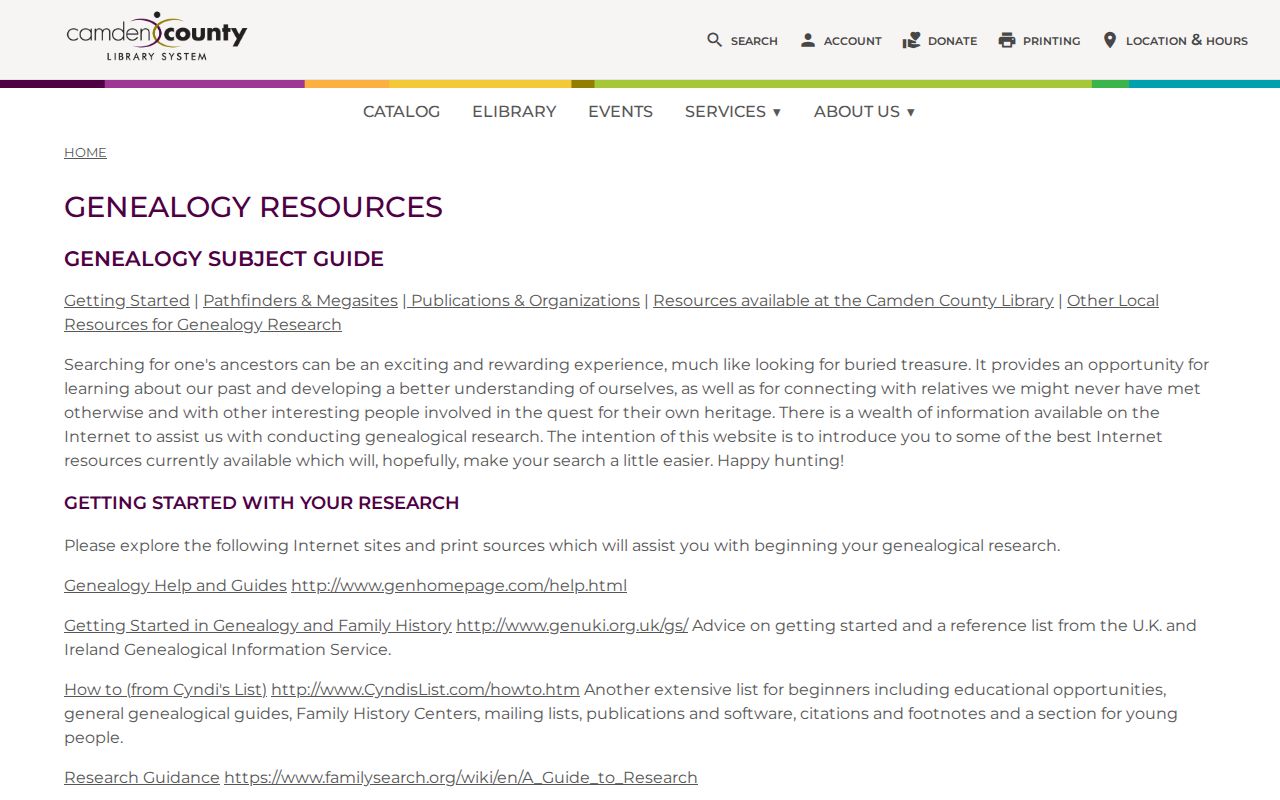
The Library resource view supports the dated directory-and-census approach needed to distinguish a prior household from a prior owner.
Gloucester Township Previous Residents and Sanborn Maps
Sanborn maps are building and site evidence, not occupant lists. CCHS names map holdings for 1885, 1891, 1906, and 1926. Depending on the sheet, they can show a building footprint, construction material, use, outbuildings, and street context. Check the exact sheet before attaching it to a Gloucester Township address because the holdings are described at the Camden County collection level. A map can help explain a building change between directory years, but it cannot prove who lived there.
The historical geography behind an address deserves equal care. Gloucester Township was part of Old Gloucester County before Camden County separated in 1844. A search may encounter a deed or directory under Old Gloucester County, Camden County, Gloucester Township, a village or section name, or a postal place. The 1850 Camden and Gloucester Directory is a useful title clue, not evidence that every similarly named result belongs to the modern municipality.
The Camden County Historical Society resource route points to the research library and the historic sources used for a property timeline.
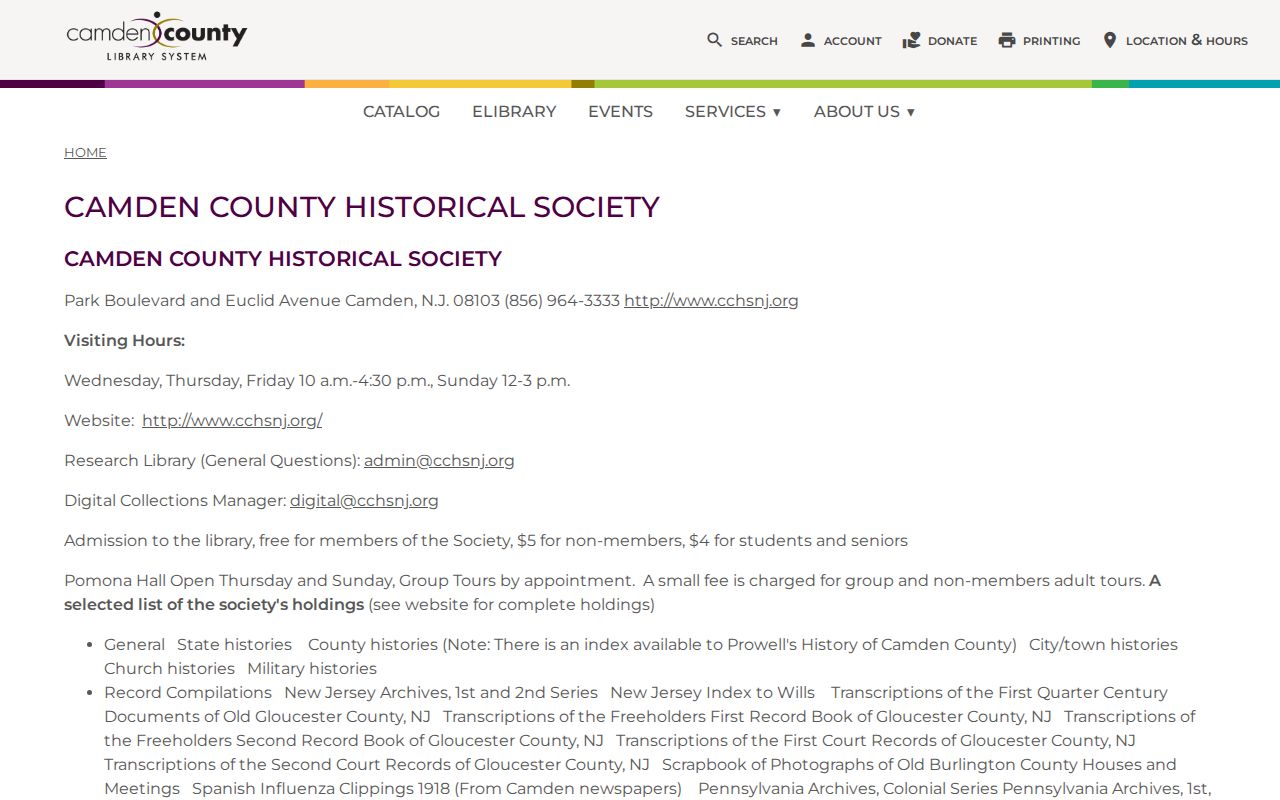
The historical-society resource view reflects the mix of deeds, maps, directories, newspapers, and cemetery records that can support an older address question.
Gloucester Township Previous Residents Address Continuity
When an address search fails, try the original route, section, postal place, and legal-description language from the earlier record. Local route names include Blackwood-Clementon, Berlin-Cross Keys, Clementon-Erial, Erial-Williamstown, Sicklerville, Blenheim-Erial/New Brooklyn, Woodbury-Turnersville, Lakeland, County House/Salina, Mt. Pleasant, and Collier. They are useful crosswalk clues, but the research did not locate an official street-renumbering or annexation-address bridge.
Compare the map's block and sheet with the Clerk's legal description. That is more reliable than forcing a present street number onto every old document. A postal name such as Blackwood, Laurel Springs, Clementon, Glendora, or Sicklerville can identify a mailing context without resolving the municipal jurisdiction. Preserve each spelling in the research notes and compare dates before merging two similarly named places.
Gloucester Township Previous Residents Trail Endpoints
Obituaries, cemetery material, probate, and newspapers can close a former-resident trail after deeds and directories have placed a person in time. Camden County Library has Courier Post microfilm from October 1949 to the present and can search an obituary when an accurate death-date window is supplied. Its online obituary coverage begins in 1999. CCHS also holds obituaries, death files, cemetery sources, newspapers, and related local-history material. An obituary's “of” or “formerly of” wording should be recorded as written rather than treated as a confirmed street address.
Probate can identify heirs or an estate connection, but court access restrictions still apply. Compare the source date, address role, and record type before calling someone a former resident. This final cross-check is especially useful when a deed transfer, census household, and directory entry point to different dates or different legal relationships.
Note: A death notice, cemetery entry, or probate file can end a research trail, but each source has its own scope and access limits.
Limits on Gloucester Township Previous Residents Research
Past-resident research is best kept to property history, family history, heir questions, and local history. An old address directory line, parcel owner, tax-mail address, and historical census household are not interchangeable. Current vital records are restricted, and New Jersey's genealogical access has age thresholds for births, marriages, and deaths. Election records, motor-vehicle data, court files, and protected addresses have separate limits. OPRA can provide a route for a non-indexed municipal file, but it does not override an exemption.
Daniel's Law and the Safe at Home program can restrict address information. Do not try to reconstruct protected information from a deed, map, directory, or other partial source. If a property or record contains an error, use the responsible custodian's correction or records-request process. The smallest targeted request is usually the most useful one.